

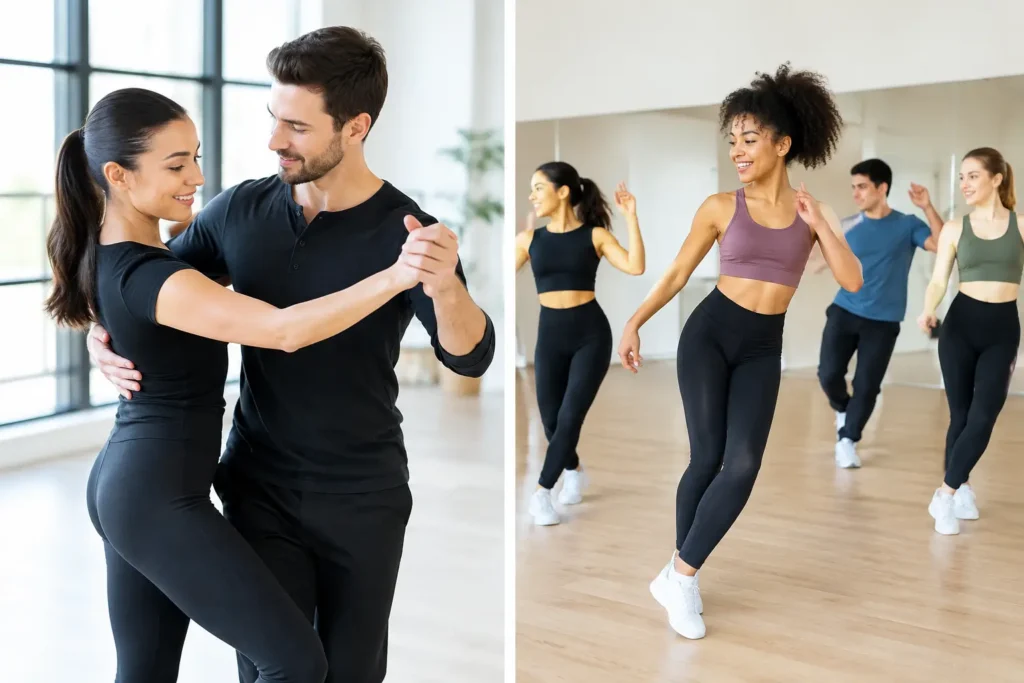
The best first dance lesson is not necessarily the one with the fewest people in the room. When choosing private versus group dance lessons, the real question is: what would help you feel excited enough to keep showing up? For one person, that is focused coaching before a wedding. For another, it is laughing through a salsa pattern alongside new friends. Both paths can take you onto the dance floor with more confidence.
At Arthur Murray Ottawa Dance Studio, students often combine both. Private instruction gives you personal direction; group classes give you practice, variety, and community. Knowing what each experience is designed to do makes the choice much easier.
Private versus group dance lessons: the central difference
Private lessons are built around you. Your instructor works with your current ability, your goals, your learning style, and the dances you want to use in real life. If you want to feel comfortable at an upcoming gala, prepare a first dance, lead and follow more clearly, or refine competitive technique, each lesson can move directly toward that goal.
Group lessons are shared learning experiences. You learn a particular dance, figure, rhythm, or concept with other students, usually at a pace that suits the class as a whole. They are energetic, social, and a wonderful reminder that everyone starts somewhere. You may rotate partners in appropriate classes, which helps singles and couples alike become more adaptable dancers.
Neither format is the “serious” option and neither is only for beginners. The better choice depends on how much individual attention you need, how quickly you want to work toward a specific result, and whether a social class atmosphere motivates you.
When private lessons make the most sense
Private lessons are especially helpful when your goal has a date attached to it. Engaged couples preparing for a first dance, for example, may want choreography that fits their song, venue, dress, comfort level, and personality. A private instructor can break the process into manageable steps so the dance feels natural rather than rehearsed under pressure.
They are also ideal if you feel nervous about starting. Many adults worry they have no rhythm, have never danced before, or will hold up a class. A one-on-one lesson gives you room to ask every question, repeat a step without embarrassment, and build a foundation at your own pace. No partner is required. If you come alone, your instructor can help you develop the skills and confidence to dance with others.
For couples, private instruction can be a refreshing shared activity because it is tailored to the way you move together. Your instructor can help with practical details that matter: clearer lead-and-follow signals, posture, timing, spacing, and how to recover gracefully when a step goes sideways. Those small adjustments often create the biggest improvement.
Experienced dancers benefit too. Once you know the basics, progress is less about collecting more patterns and more about quality. Private coaching can focus on musicality, technique, styling, connection, or a specific competitive routine. That precision is hard to replicate in a class designed for several people at once.
The trade-off is that private lessons are more concentrated. You receive focused feedback and a customized plan, but you will want to create chances to practice what you learn. Social dance events and group classes can provide that valuable extra floor time.
Private lessons are a strong fit if you want:
A personalized plan, flexible scheduling, direct feedback, fast progress toward a specific occasion, or support with a dance challenge that feels personal. They are a practical choice for wedding couples, busy professionals, complete beginners, and dancers pursuing higher-level goals.
Why group lessons bring a different kind of progress
Group classes offer something private lessons cannot fully reproduce: the buzz of learning in a room full of people who are working toward the same goal. You hear the music start, try the pattern together, miss a turn, get it on the next attempt, and realize that dancing can be a joyful social skill rather than a test.
For singles, groups can be an easy, welcoming way to meet people without the pressure of needing to arrive with a partner. For couples, they offer a chance to practice dancing with a little more independence. Learning to adapt to different partners, timing, and lead-and-follow styles can make you more comfortable at parties, receptions, and social events.
Group classes also introduce variety. You might come in because you want to learn swing, then find that you love rumba, country two-step, bachata, or a lively club dance. That exposure can help new dancers discover what feels most natural and fun.
The pace, however, is shared. An instructor can demonstrate, correct common issues, and keep the room moving, but they cannot pause the entire class for every student’s individual question. If you need extra repetition or have a very specific objective, pairing group learning with private instruction can prevent frustration.
Group lessons are a strong fit if you want:
More social practice, exposure to several dances, an encouraging community, and a regular reason to get out and move. They work beautifully for dancers who learn well by observing others and for anyone who wants their hobby to include new friendships.
Your goal should choose the format
If your goal is “I want to stop sitting at weddings,” group classes may be exactly the friendly push you need. You will learn usable steps, hear different rhythms, and gain comfort in a room where people are learning alongside you.
If your goal is “Our first dance is eight weeks away,” private lessons are likely the clearest starting point. You can work on a dance that fits your song and build confidence without wasting time on material unrelated to your moment.
If your goal is “I want a lasting hobby,” do not force yourself to choose one format forever. A private lesson can give you a solid foundation and keep your technique moving forward. Group classes and studio events give that foundation a place to come alive. This combination is often the most rewarding option because it connects instruction with real social experience.
For competitive hobby dancers, the balance can be especially useful. Private coaching supports detailed preparation, while groups and events help maintain versatility, stamina, and a sense of fun. Dance grows faster when it is both purposeful and enjoyable.
Consider how you like to learn
Think back to the last time you learned a new skill. Did you want someone beside you, correcting the small details as you went? Or did you enjoy watching a room, trying it out, and learning through repetition? Your answer is useful.
Private students often value privacy, individual feedback, and a pace that can speed up or slow down as needed. Group students often enjoy structure, shared energy, and the motivation that comes from a weekly class. There is no prize for choosing the format that sounds more ambitious. The right lesson is the one that helps you return next week feeling a little more capable than before.
Budget and schedule matter as well. Group classes can be an accessible way to add dance to your routine, while private lessons offer more scheduling flexibility and a highly tailored use of your time. Ask about program options rather than assuming you must commit to only one route.
Start where the pressure feels lowest
You do not need rhythm, experience, fancy shoes, or a partner to begin. You need a comfortable first step and an instructor who can meet you there. A trial lesson is a simple way to see how personalized coaching feels, ask questions about your goals, and decide whether group classes, private lessons, or a combination is right for you.
Choose the setting that makes you most willing to step onto the floor. The confidence, connection, and happy memories tend to follow once you do.