

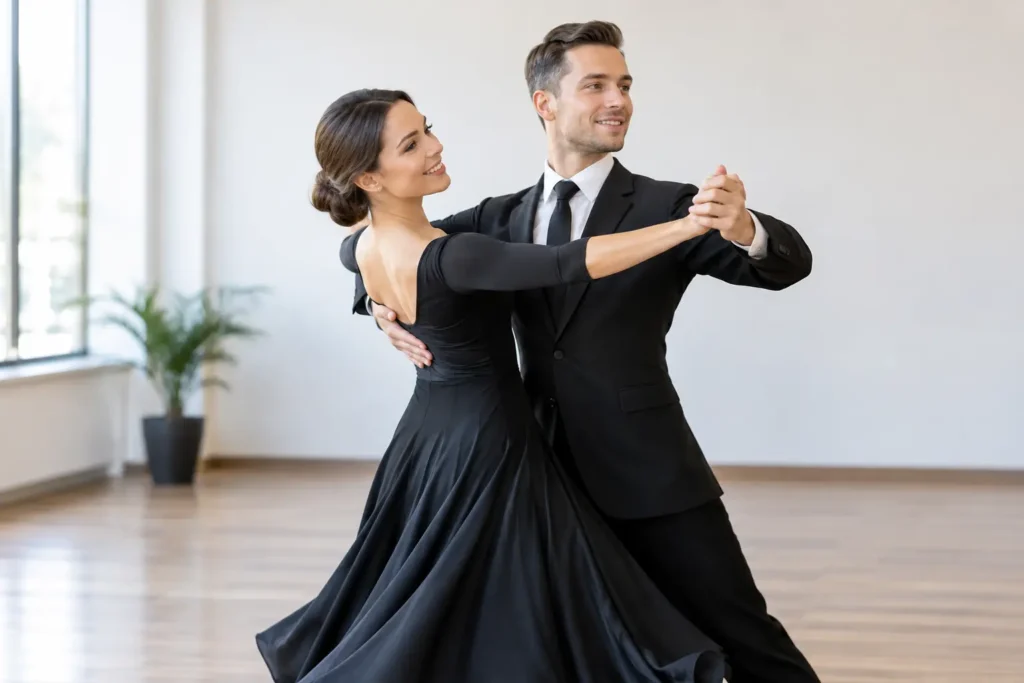
The moment a couple travels across the floor, opens into a graceful turn, and reconnects with ease, American Smooth feels less like a set of steps and more like a conversation. American Smooth dance lessons give you the technique to create that feeling – whether you are beginning from scratch, preparing for a special event, or ready to bring more expression to your ballroom dancing.
This style is polished, joyful, and surprisingly welcoming. You do not need a dance partner, previous training, or a performer’s personality to start. You only need the willingness to take one guided step at a time.
What Makes American Smooth Different?
American Smooth is a ballroom category built around four familiar dances: Waltz, Tango, Foxtrot, and Viennese Waltz. Each dance has its own personality. Waltz is romantic and flowing, Tango is dramatic and grounded, Foxtrot has an easy, sophisticated glide, and Viennese Waltz brings joyful rotation and energy.
What sets Smooth apart is freedom of movement. Partners begin with the strong frame and connection associated with traditional ballroom, but they can also open out, dance side by side, turn separately, and reconnect. Those moments create the sweeping shapes and expressive transitions that make Smooth so memorable to watch.
That freedom does not mean guessing your way through the dance. It is built on clear fundamentals: posture, timing, balance, lead and follow, and floor awareness. When those pieces are in place, the open moments feel natural rather than rushed or choreographed for show.
Who Can Enjoy American Smooth Dance Lessons?
Smooth appeals to people for different reasons, and that is part of its charm. Couples often love the shared goal and the opportunity to move together with more ease. Singles appreciate learning a social skill, improving coordination, and meeting a welcoming dance community. Experienced dancers may choose Smooth because it offers a new creative challenge beyond staying in one closed position.
It can also be a wonderful choice for a wedding couple. A flowing Waltz or Foxtrot can create a beautiful first dance without requiring lifts, tricks, or a complicated routine. If your reception space is tight or your song has a very quick tempo, another style may be a better fit. A certified instructor can help you choose movement that looks elegant, feels comfortable, and suits the room you will actually be dancing in.
For beginners, the goal is not to memorize every figure in all four dances at once. Your first lessons focus on feeling steady, moving to music, and understanding how partners communicate. Confidence grows much faster when learning is personalized instead of rushed.
What You Will Learn First
A good Smooth lesson begins with the foundations that make every dance more enjoyable. You will learn how to stand with poise without feeling stiff, how to take a comfortable ballroom hold, and how to move your body as a unit rather than watching your feet.
From there, your instructor may introduce a simple box pattern in Waltz, a walking action in Tango, or the smooth rise and fall that gives Foxtrot its floating quality. These are not just basic exercises. They teach the weight changes and timing that let you move confidently with another person.
Lead and Follow Is a Shared Skill
Leading is not about pulling or pushing a partner through a pattern. Following is not about being passive. In American Smooth, both partners contribute to a clear, responsive connection. The leader suggests direction and timing; the follower reads that information and completes the movement with balance and expression.
Students often find this part especially encouraging. You do not have to predict every step. With the right technique, dancing becomes less about remembering a long sequence and more about responding to the music and your partner.
Open Work Comes at the Right Time
Those beautiful open turns, underarm passes, and side-by-side moments are exciting, but they work best after you have a dependable connection. Your instructor will introduce them at a pace that makes sense for your experience level.
For some students, that happens quickly because they already have ballroom experience. For others, spending more time on rhythm and posture creates a better result. There is no prize for racing ahead. The real reward is looking relaxed and feeling in control when the music starts.
Why Private Instruction Makes a Difference
American Smooth has room for personal style, which is exactly why individualized feedback matters. A private lesson can address the details that are easy to miss in a group setting: where your weight is placed, how your shoulders stay calm during a turn, or how much space a couple needs to travel safely.
At Arthur Murray Ottawa Dance Studio, certified instructors use a step-by-step approach that adapts to your goals and pace. A beginner who wants to feel comfortable at a party needs a different plan than a couple preparing a first dance or a hobby dancer interested in showcase and competition events.
Group classes and studio dance parties add another valuable layer. They give you a chance to practice with different partners, hear more music, and use your skills in a friendly social setting. Private coaching builds precision; social practice helps that precision become usable confidence.
Smooth Technique That Helps You Beyond the Studio
One of the best parts of learning Smooth is that the progress shows up in everyday ways. You may notice better posture at work, more comfort walking into a room, and a new willingness to say yes when a band starts playing. Dancing also asks for focus, coordination, and light physical activity without making exercise feel like a chore.
The benefits are not only individual. Couples often enjoy having a regular activity that is not another dinner reservation or screen-based routine. Learning together creates shared wins: the first successful turn, the first time a song feels easy, the first compliment from friends at a social event.
There will be awkward moments, too. Everyone has them. A missed direction, a laugh after stepping on a toe, or a turn that arrives late is simply feedback, not failure. The most confident dancers are usually the ones who kept showing up long enough to stop treating mistakes as a reason to quit.
Choosing the Right Goal for Your Lessons
Before your first lesson, think about what would make dancing meaningful for you. You may want to feel comfortable at weddings and galas, create a memorable first dance, improve your ballroom technique, or work toward a performance goal. Your reason shapes the lesson plan.
If social dancing is your priority, you may spend more time on lead and follow, adaptable patterns, and navigating a shared floor. If you are preparing for a wedding, your lessons can focus on your chosen song, entrances, turns, and a finish that feels like you. If competition or performance appeals to you, you may work more deeply on styling, alignment, musical interpretation, and routines.
American Smooth can support all of these goals, but the path is not identical for everyone. The right program meets you where you are and gives you a clear next step.
What to Wear and How to Prepare
Wear clothing that lets you move comfortably. Shoes that stay secure on your feet are a better choice than loose sandals or very sticky athletic shoes. You do not need special dancewear for your first lesson, though shoes with a smooth sole can become helpful as you progress.
Come ready to ask questions and give yourself permission to be new. You do not need to study videos or arrive knowing dance terminology. An instructor can explain the vocabulary as you learn, correct small habits before they become frustrating, and keep the experience enjoyable.
The next time you picture yourself on a dance floor, picture more than the steps. Picture moving with ease, sharing a song, and knowing you belong there. Book a trial lesson, bring your curiosity, and let the first few counts become the start of something you will be glad you tried.